Budget Revote
The school budget was voted down on May 19th. Unique to New York state, education law allows a revote - if it goes the ‘wrong’ way. This revote will be held on June 16th at Ward Melville High School. Before voting there are a few things to consider.
The Debt
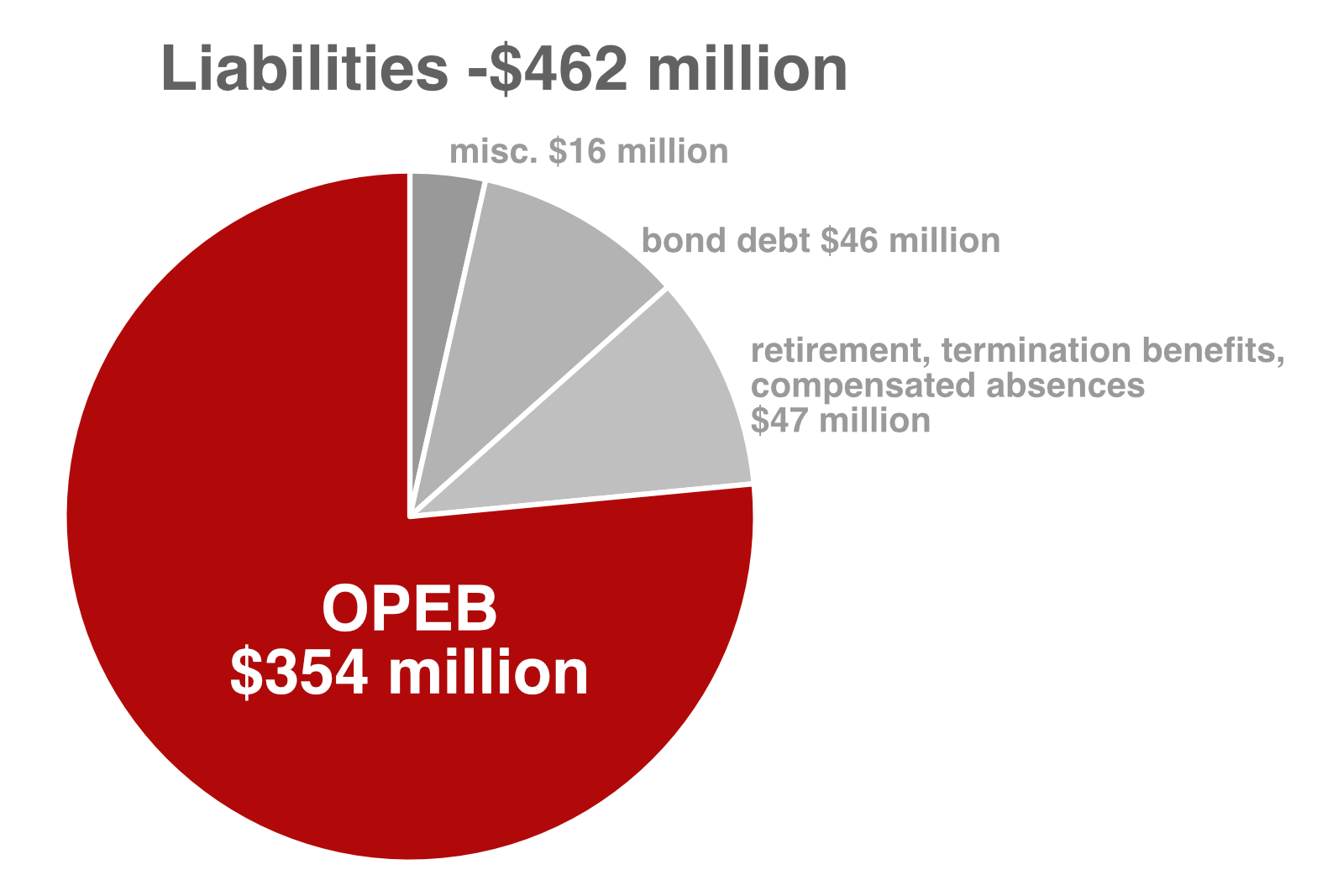
This first graph shows the Long-term Liabilities of the Three Village District (1). It is an impressively large number: $462 million. This is the money we owe. This liability has four main components:
Bond Debt
Retirement, termination benefits & compensated absences
Miscellaneous
OPEB
OPEB is the dark matter of school district debt. It is rarely discussed publicly but it exerts a gravitational pull on almost every budgetary decision. OPEB stands for “Other Post-Employment Benefits”. OPEB is the health insurance costs for former district employees. We currently pay between 82% and 100% of the health insurance for former district employees for life out of funds intended for education.
At the district’s recent ‘listening session’ a retired couple spoke about their difficulties staying in the district and how they were afraid of being forced to leave their family, home and friends by high property taxes. It cannot be emphasized enough that struggling local seniors are being forced to pay for the gold-plated health plans of school administrators who retired with unusually generous pensions. It is very difficult to justify this from any coherent political, ethical, educational or economic perspective.
The Downgrade
The school district’s credit rating was recently downgraded by Moody’s. We currently pay over $41,000 per student. We rank 6th highest in the nation for costs per pupil for schools of comparable size (2). Why is our credit rating deteriorating? Moody’s cited “sustained erosion of available fund balance and liquidity, leaving reserves materially below similarly rated peers”.
The school district has a general fund, our cash assets, the money we have in the bank. This graph shows that each year we took away a fraction of our capital and it was never replenished. We have been eating our seed corn for at least a decade. It is this decline in the fund balance together with the absolute size of the debt relative to our assets that caught Moody’s attention resulting in the rating downgrade.
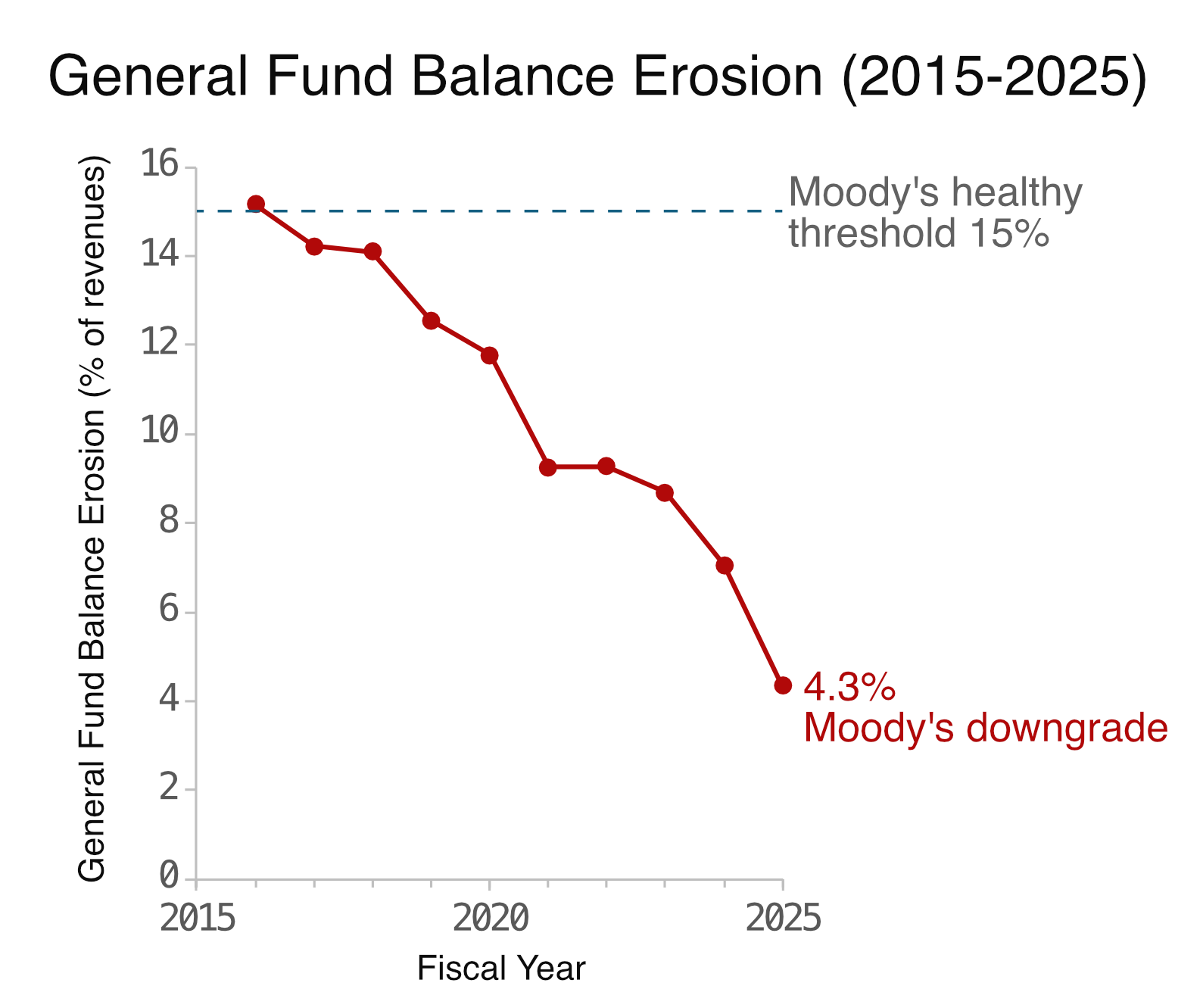
The erosion of our financial position has been steady. It is not the case that a single event such as Covid is responsible for this decline, it is primarily driven by the continually increasing retiree health care costs.
There are three ways back to financial stability.
The unions could agree to a substantial increase in their contribution to health care costs. This could then propagate to retirees (Donohue v. Cuomo, 2022).
The unions could agree to move some retiree medical costs to Medicare Advantage, where the federal government picks up approximately 30% of the retiree health costs (Bentkowski v. City of New York, 2025).
The unions could implement their Cuts4Kids program, advocating for cuts to school programs rather than restructuring retiree health care costs.
The Vote
During a recent school board meeting (5/29) a majority of board trustees voted for an even larger tax increase than was requested by the administration. They also suggested that we should send school children out to fundraise for the district. This is literally insane. The district does not have a revenue problem, it has more money than 99% of comparable districts in the country. It has a very big cost problem. It is important to understand that the only person protecting your family’s interests is you. It is worthwhile getting out to vote.
Solutions
There are no simple solutions but the lack of financial planning and absence of adequate conflict of interest guardrails for the board are two key problems. We are putting forward two propositions to address these problems and are looking for signatures.
Propositions
What were they thinking?
Two types of bullshit
Notes
1. Graph shows FY2025 total liabilities, grouped into 4 categories. All figures from the Three Village CSD FY2025 audited financial statements, Statement of Net Position.
2. Data is drawn from Three Village CSD's audited financial statements for fiscal years 2016 through 2025.